Construct a logic expression
3.2 Logic Gates and Logic Circuits
Objective
By the end of this lesson you will be able to construct a logic expression, a truth table, and a logic circuit from any of the following:
- a written description (English),
- a circuit diagram, or
- a truth table.
You will also be able to simplify Boolean expressions using Boolean algebra and, for A‑Level, minimise them with Karnaugh maps.
1. Required Logic Gates (two‑input only)
| Gate | Boolean Symbol | Logic Symbol | Truth Table (A, B → Output) | |||||||||||||||
|---|---|---|---|---|---|---|---|---|---|---|---|---|---|---|---|---|---|---|
| AND | \$A\!\cdot\!B\$ | 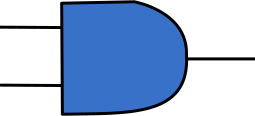 |
|
|||||||||||||||
| OR | \$A + B\$ | 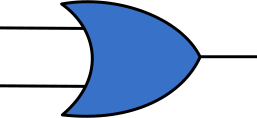 |
|
|||||||||||||||
| NOT (inverter) | \$\overline{A}\$ or \$\lnot A\$ | 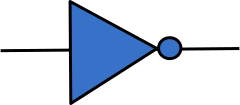 |
|
|||||||||||||||
| NAND | \$\overline{A\!\cdot\!B}\$ | 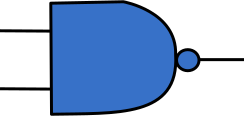 |
|
|||||||||||||||
| NOR | \$\overline{A + B}\$ |  |
|
|||||||||||||||
| XOR | \$A \oplus B\$ | 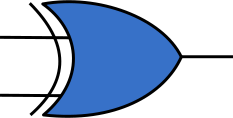 |
|
Note: In the Cambridge syllabus every gate (except NOT) has exactly two inputs. When a problem requires a three‑input AND, OR, etc., you must cascade
2. Operator Precedence
- NOT (¬) – highest
- AND (·) – next
- XOR (⊕) – evaluated after AND
- OR (+) – lowest
Always use parentheses to make the intended order explicit, especially when mixing AND, XOR and OR.
3. Constructing Truth Tables
3.1 From a Problem Statement (English)
- List every distinct condition and assign a single‑letter variable.
- Create a column for each variable and one column for the required output.
- Write every possible combination of inputs – for n variables there are \$2^{n}\$ rows.
- For each row, evaluate the English condition and place
1(true) or0(false) in the output column.
3.2 From a Logic Expression
- Set up the same input columns as above.
- Apply the operator precedence (NOT → AND → XOR → OR) to evaluate the expression for each row.
- Record the result in the output column.
3.3 From a Logic Circuit
- Identify all input variables and the final output node.
- Label each gate with its Boolean symbol.
- Follow the signal flow from the inputs through each gate, evaluating the gate function for every row of the input combinations.
Worked Example – Alarm System
Problem: “The alarm sounds if the door is open and the system is armed, or if a fire is detected while the system is not armed.”
- \$D\$ – Door open
- \$A\$ – System armed
- \$F\$ – Fire detected
- \$S\$ – Alarm sounds (output)
Boolean expression (derived in Section 4.1):
\$S = (D\!\cdot\!A) + (F\!\cdot\!\overline{A})\$
| D | A | F | \$\overline{A}\$ | \$D\!\cdot\!A\$ | \$F\!\cdot\!\overline{A}\$ | S |
|---|---|---|---|---|---|---|
| 0 | 0 | 0 | 1 | 0 | 0 | 0 |
| 0 | 0 | 1 | 1 | 0 | 1 | 1 |
| 0 | 1 | 0 | 0 | 0 | 0 | 0 |
| 0 | 1 | 1 | 0 | 0 | 0 | 0 |
| 1 | 0 | 0 | 1 | 0 | 0 | 0 |
| 1 | 0 | 1 | 1 | 0 | 1 | 1 |
| 1 | 1 | 0 | 0 | 1 | 0 | 1 |
| 1 | 1 | 1 | 0 | 1 | 0 | 1 |
4. Deriving Logic Expressions
4.1 English → Boolean
- Identify each distinct condition and give it a single‑letter variable.
- Translate the condition into a Boolean clause using the gate definitions (AND = “both”, OR = “either”, NOT = “not”).
- Combine the clauses with the appropriate operators; use parentheses to show the intended grouping.
4.2 From a Truth Table (Canonical Sum‑of‑Products)
- Write the complete truth table, marking the rows where the output is 1.
- For each “1” row, write a product (AND) term that is true only for that row:
- Use the variable itself if the input is 1.
- Use its complement (¬) if the input is 0.
- Join all product terms with OR. The result is the canonical sum‑of‑products (SOP) expression.
- Optionally simplify the SOP using Boolean algebra (Section 5) or Karnaugh maps (A‑Level).
4.3 From a Logic Circuit
- Label every gate with its Boolean symbol.
- Starting at the output, replace each gate by its algebraic form, working backwards toward the inputs.
- Continue until the expression contains only the original input variables.
Worked Example – Deriving the Alarm Expression from the Circuit

- Top AND gate → \$D\!\cdot\!A\$
- Bottom AND gate → \$F\!\cdot\!\overline{A}\$ (the NOT gate provides \$\overline{A}\$)
- OR gate combines the two products → \$(D\!\cdot\!A) + (F\!\cdot\!\overline{A})\$
5. Constructing Logic Circuits
5.1 From a Problem Statement
- Write the Boolean expression using the steps in Section 4.1.
- Replace each operator by its corresponding gate symbol (AND → •, OR → +, NOT → ⊼, NAND/NOR → bubble, XOR → ⊕).
- Draw the gates with two inputs (except NOT) and connect them exactly as the parentheses dictate.
5.2 From a Truth Table (Sum‑of‑Products Method)
- Form the canonical SOP expression (Section 4.2).
- Implement each product term with a two‑input AND gate; use a NOT gate for any complemented variable.
- Combine all product terms with a single two‑input OR gate. If more than two product terms are needed, cascade additional OR gates.
5.3 From a Logic Expression
- Identify the innermost parentheses – they become the first gates.
- Proceed outward, adding a gate for each operator.
- If an operator has more than two inputs, split it into several two‑input gates (cascading). For example, a three‑input AND \$A\!\cdot\!B\!\cdot\!C\$ is built as \$(A\!\cdot\!B)\!\cdot\!C\$ using two AND gates.
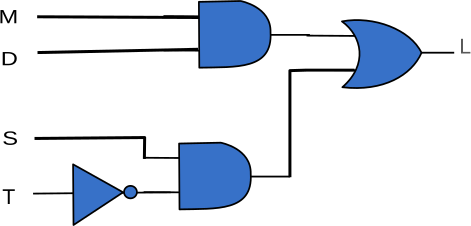
Worked Example – Light Control Circuit
- Variables: \$M\$ (motion), \$D\$ (dark), \$S\$ (manual switch), \$T\$ (timer active)
- Expression: \$L = (M\!\cdot\!D) + (S\!\cdot\!\overline{T})\$
6. Boolean Algebra – Simplifying and Minimising
6.1 Core Identities (useful for AS‑Level)
- Identity: \$A + 0 = A,\; A\!\cdot\!1 = A\$
- Null: \$A + 1 = 1,\; A\!\cdot\!0 = 0\$
- Idempotent: \$A + A = A,\; A\!\cdot\!A = A\$
- Complement: \$A + \overline{A} = 1,\; A\!\cdot\!\overline{A} = 0\$
- De Morgan: \$\overline{A + B} = \overline{A}\!\cdot\!\overline{B}\$, \$\overline{A\!\cdot\!B} = \overline{A} + \overline{B}\$
- Distributive: \$A\!\cdot\!(B + C) = (A\!\cdot\!B) + (A\!\cdot\!C)\$, \$A + (B\!\cdot\!C) = (A + B)\!\cdot\!(A + C)\$
6.2 Karnaugh Maps (A‑Level minimisation)
K‑maps provide a visual method for simplifying SOP or POS expressions.
- For two variables, the map is a 2 × 2 grid. Fill the cells with the output values from the truth table.
- Group adjacent 1’s in powers of two (1, 2, 4, 8 …). Each group yields a simplified product term.
- Combine the terms to obtain the minimal expression.
Example (2‑variable K‑map):
| B=0 | B=1 | |
|---|---|---|
| A=0 | 0 | 1 |
| A=1 | 1 | 1 |
Grouping the three 1’s gives the minimal expression \$A + \overline{B}\$.
6.3 Flip‑Flops (Sequential Logic – A‑Level)
While this unit focuses on combinational circuits, A‑Level students must recognise the two basic types of flip‑flops used in sequential circuits:
- SR (Set‑Reset) flip‑flop: inputs S and R control the stored state; the characteristic table is \$Q_{next}=S+\overline{R}\!\cdot\!Q\$.
- JK flip‑flop: a refinement of SR that eliminates the illegal “1‑1” condition; characteristic equation \$Q_{next}=J\!\cdot\!\overline{Q}+ \overline{K}\!\cdot\!Q\$.
In circuit diagrams they are shown with a rectangle containing the name (e.g., “SR”) and clock input symbols. Understanding these symbols is essential for Paper 3 questions on sequential circuit design.
7. A‑Level Extension Box
For students planning to sit the A‑Level Computer Science examination, the following topics extend the material covered above:
- Minimisation of Boolean expressions using Karnaugh maps (3‑ and 4‑variable maps).
- Design of combinational circuits from Karnaugh‑derived expressions.
- Sequential circuit design: SR, JK, D and T flip‑flops; timing diagrams; state tables.
- Implementation of arithmetic circuits (half‑adder, full‑adder, binary subtractor).
- Use of NAND‑only and NOR‑only implementations (gate‑level optimisation).
8. Common Pitfalls
- Applying NOT to the wrong variable (e.g., writing \$F\!\cdot\!A\$ instead of \$F\!\cdot\!\overline{A}\$).
- Confusing “either … or … but not both” with simple OR – it requires an XOR gate.
- Omitting parentheses; remember the precedence order NOT → AND → XOR → OR.
- Assuming a gate can have more than two inputs; always cascade two‑input gates.
- Mixing logical operators (used in Boolean expressions) with bit‑wise operators (used in programming). In the syllabus, “AND”, “OR”, “NOT” refer to logical operations on binary values.
- Neglecting the exclusive nature of XOR – it outputs 1 only when exactly one input is 1.
9. Summary Checklist
- Identify all input variables and give each a clear symbol.
- Translate English conditions into Boolean clauses using the correct gate definitions.
- Write the Boolean expression with explicit parentheses.
- Check operator precedence (NOT → AND → XOR → OR) or add parentheses to avoid ambiguity.
- Draw the corresponding two‑input circuit, cascading gates where necessary.
- Validate your work by constructing a truth table or testing a few input combinations.
- If required (A‑Level), simplify the expression using Boolean algebra, Karnaugh maps, or NAND/NOR‑only techniques.
10. Practice Questions
- Expression construction: Write a Boolean expression for “The sprinkler activates if the temperature exceeds a threshold and it is not raining, or if the soil moisture is low.” (Define variables yourself.)
- Truth table from expression: For \$Y = \overline{A}\!\cdot\!B + A\!\cdot\!\overline{C}\$, produce the complete truth table.
- Derive expression from truth table: Given the table below, write the canonical sum‑of‑products expression and then simplify it using Boolean algebra.
- Circuit drawing: From the expression \$Z = (P + Q)\!\cdot\!\overline{R}\$, draw the two‑input logic circuit, showing all gates and connections.
- A‑Level challenge (K‑map): Minimise the expression \$F(A,B,C,D) = \sum m(1,3,4,6,9,11,12,14)\$ using a 4‑variable Karnaugh map.
| A | B | C | Output |
|---|---|---|---|
| 0 | 0 | 0 | 0 |
| 0 | 0 | 1 | 1 |
| 0 | 1 | 0 | 1 |
| 0 | 1 | 1 | 0 |
| 1 | 0 | 0 | 1 |
| 1 | 0 | 1 | 0 |
| 1 | 1 | 0 | 0 |
| 1 | 1 | 1 | 1 |